


【SDG 11】New Taipei City shares experience in low-carbon building governance at MITI Workshop
2026-07-24
Situated in an earthquake-prone region with abundant rainfall, Taiwan boasts a unique environment. The Metropolis International Training Institute (MITI) organized a workshop entitled "Climate Adaptation and Mitigation: Towards Low-Carbon Buildings" from April 27 to 29, 2026. Invited to an online session on April 28, New Taipei City showcased its practical achievements in promoting net-zero emissions and low-carbon building governance, as well as its experience in sustainable urban transformation.
Hosted by MITI, this workshop was held in Cairo, Egypt, in a hybrid format, combining in-person participation with online attendance. It brought together city representatives from around the world to discuss the key role of the building sector in climate adaptation and low-carbon transition. The New Taipei City Government especially invited architect Kun-Jung Hsu from the New Taipei City Architects Association to give a keynote speech entitled "Climate Adaptation and Mitigation: Towards Low-Carbon Buildings—A Glocalized Governance Approach" sharing how the building sector can lead the private sector in promoting net-zero transformation through institutional governance.
Hsu pointed out that constructing net-zero buildings involves not only technical hurdles but also governance challenges. The core issue lies in establishing clear definitions and testing and certification systems for building material performance, while balancing technical feasibility with financial affordability and social equity. He noted that if high-performance, low-carbon building materials carry an excessive green premium, low- to middle-income communities and small-and medium-sized construction companies may be priced out of the transformation.
He also compared the different governance models of Singapore, Japan, and Taiwan. Singapore adopts a mandatory regulatory approach, setting high standards and thresholds through building regulations and centralized procurement of public housing. Japan incorporates earthquake resistance and asset value in its long-life housing system, regarding building material performance as a part of household asset protection. Taiwan promotes market transparency through the Building Energy-Efficiency Rating System (BERS), life cycle assessments (LCA), and big data databases. This lowers the technical barriers for SMEs to adopt low-carbon building materials and forms a governance model centered on information empowerment.
The building sector stands as a critical pillar of urban carbon reduction. In the Greater Taipei Metropolitan Area, the carbon emissions from Taipei City's building sector account for as much as 74.6%, while New Taipei City's account for 39.4%. Therefore, "Double-North Priority" has become an important strategy for Taiwan's net-zero transformation of buildings. New Taipei City is currently accelerating carbon reduction in its high-density urban areas through building energy conservation, urban renewal, energy efficiency labeling, and low-carbon building materials.
In terms of policy implementation, New Taipei City also introduced Taiwan's Low Embodied-carbon Building Rating System (LEBR). Set to launch in 2027, the system seeks to promote carbon reduction throughout the entire life cycle of buildings using a dual-track mechanism. The public sector will fully adopt building information modeling (BIM) for carbon emission estimation. Meanwhile, a voluntary labeling system has been established to incentivize the private sector to engage in low-carbon building material innovation through scoring. Such measure aims to expand carbon reduction in buildings from the operational phase to the entire life cycle, covering raw materials used, production, construction, and renovation.
Architect Hsu’s presentation also highlighted the concept of "Tiered Compliance," which propounds that while maintaining a consistent net-zero target, flexible implementation routes should be provided for projects of different scales. Large-scale development projects can leverage BIM for precise calculations and full certification, while small-scale community renewal and residential renovations can promote carbon reduction through simplified estimation methods based on databases. This ensures that rather than a high-cost option, sustainability can be truly realized in various communities and building sites.
In response to the global push toward net zero, New Taipei City believes that technological innovation must be matched by a system design that prioritizes both equity and accessibility. Through this exchange with international cities, New Taipei City will continue to deepen international cooperation, benchmark the experiences of various countries, and advance a more resilient, livable, and sustainable urban development strategy, steadily achieving the goal of becoming a net-zero city by 2050.
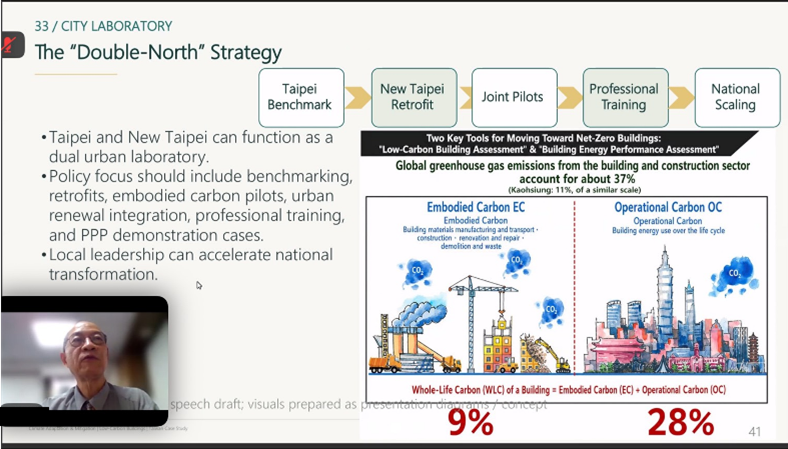
Architect Kun-Jung Hsu analyzes the policies of Taipei and New Taipei City.
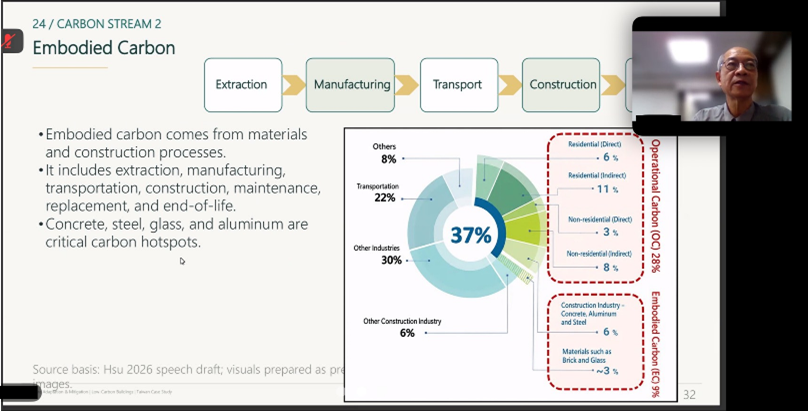
Architect Kun-Jung Hsu shares insights on embodied carbon.相關連結
相關連結
Hosted by MITI, this workshop was held in Cairo, Egypt, in a hybrid format, combining in-person participation with online attendance. It brought together city representatives from around the world to discuss the key role of the building sector in climate adaptation and low-carbon transition. The New Taipei City Government especially invited architect Kun-Jung Hsu from the New Taipei City Architects Association to give a keynote speech entitled "Climate Adaptation and Mitigation: Towards Low-Carbon Buildings—A Glocalized Governance Approach" sharing how the building sector can lead the private sector in promoting net-zero transformation through institutional governance.
Hsu pointed out that constructing net-zero buildings involves not only technical hurdles but also governance challenges. The core issue lies in establishing clear definitions and testing and certification systems for building material performance, while balancing technical feasibility with financial affordability and social equity. He noted that if high-performance, low-carbon building materials carry an excessive green premium, low- to middle-income communities and small-and medium-sized construction companies may be priced out of the transformation.
He also compared the different governance models of Singapore, Japan, and Taiwan. Singapore adopts a mandatory regulatory approach, setting high standards and thresholds through building regulations and centralized procurement of public housing. Japan incorporates earthquake resistance and asset value in its long-life housing system, regarding building material performance as a part of household asset protection. Taiwan promotes market transparency through the Building Energy-Efficiency Rating System (BERS), life cycle assessments (LCA), and big data databases. This lowers the technical barriers for SMEs to adopt low-carbon building materials and forms a governance model centered on information empowerment.
The building sector stands as a critical pillar of urban carbon reduction. In the Greater Taipei Metropolitan Area, the carbon emissions from Taipei City's building sector account for as much as 74.6%, while New Taipei City's account for 39.4%. Therefore, "Double-North Priority" has become an important strategy for Taiwan's net-zero transformation of buildings. New Taipei City is currently accelerating carbon reduction in its high-density urban areas through building energy conservation, urban renewal, energy efficiency labeling, and low-carbon building materials.
In terms of policy implementation, New Taipei City also introduced Taiwan's Low Embodied-carbon Building Rating System (LEBR). Set to launch in 2027, the system seeks to promote carbon reduction throughout the entire life cycle of buildings using a dual-track mechanism. The public sector will fully adopt building information modeling (BIM) for carbon emission estimation. Meanwhile, a voluntary labeling system has been established to incentivize the private sector to engage in low-carbon building material innovation through scoring. Such measure aims to expand carbon reduction in buildings from the operational phase to the entire life cycle, covering raw materials used, production, construction, and renovation.
Architect Hsu’s presentation also highlighted the concept of "Tiered Compliance," which propounds that while maintaining a consistent net-zero target, flexible implementation routes should be provided for projects of different scales. Large-scale development projects can leverage BIM for precise calculations and full certification, while small-scale community renewal and residential renovations can promote carbon reduction through simplified estimation methods based on databases. This ensures that rather than a high-cost option, sustainability can be truly realized in various communities and building sites.
In response to the global push toward net zero, New Taipei City believes that technological innovation must be matched by a system design that prioritizes both equity and accessibility. Through this exchange with international cities, New Taipei City will continue to deepen international cooperation, benchmark the experiences of various countries, and advance a more resilient, livable, and sustainable urban development strategy, steadily achieving the goal of becoming a net-zero city by 2050.
Architect Kun-Jung Hsu analyzes the policies of Taipei and New Taipei City.
Architect Kun-Jung Hsu shares insights on embodied carbon.
 Visitor:96